
This guide answers 'How Do I Hire Professional Dancers for an Event?'. Learn to define your vision, budget, and vet performers. Book top talent today!
What Is An Aerialist?
If you’ve ever been captivated by the gravity-defying feats at a circus or a high-end corporate event, you’ve likely wondered, What is an aerialist? An aerialist is a highly skilled performance artist who executes acrobatics and dance movements while suspended from an apparatus. These performers combine immense strength, flexibility, and artistic expression to create breathtaking displays high above the ground. Consequently, they represent a unique and memorable form of live entertainment.
The Demands of Aerial Arts: More Than Just Flying
Becoming an aerialist is a journey of intense physical and mental dedication. The training is rigorous, often involving daily conditioning to build the necessary upper body and core strength. Furthermore, flexibility is just as crucial, allowing for the fluid, graceful lines that define aerial performance. Performers must also develop a deep understanding of their apparatus, safety procedures, and the physics of movement in the air. This discipline is not just about athletic prowess; it’s about creating a seamless connection between the artist and their equipment.
For example, an aerialist on a trapeze must calculate swings and momentum perfectly, while a silks performer must master intricate wraps and drops. Importantly, this dedication ensures not only a stunning performance but also the safety of the artist. As a result, audiences can trust they are watching a true professional who has honed their craft over thousands of hours.
What Are the Different Types of Aerial Arts?
The world of aerial arts is diverse, with several distinct disciplines, each requiring a unique set of skills. While some aerialists specialize in one apparatus, many are proficient in several. This versatility makes them a fantastic choice when choosing the right entertainment talent for a varied audience.
Aerial Silks (Tissu)
Perhaps one of the most recognized forms, aerial silks involve two long pieces of fabric suspended from the ceiling. Aerialists climb, wrap, and drop within the fabric, creating elegant poses and thrilling descents. The performance appears effortless, but it demands incredible grip strength and endurance. Therefore, it is a testament to the artist’s power.
Lyra (Aerial Hoop)
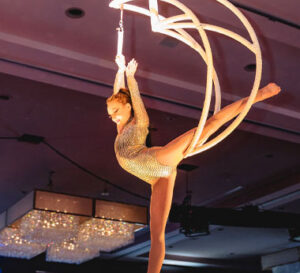
The lyra is a circular steel apparatus, similar to a hula hoop, suspended in the air. Performers use the hoop to execute dynamic spins, swings, and static poses. It offers a different style of movement compared to silks, often focusing on seamless transitions and mesmerizing circular motions. Similarly to other disciplines, it requires a strong core and precise control.
Static and Flying Trapeze
The trapeze is a classic circus art. On a static trapeze, the bar is mostly stationary, and the aerialist performs poses and movements on and around it. In contrast, the flying trapeze involves two performers, with one swinging and releasing to be caught by the other. This requires impeccable timing and trust between partners.
Beyond these common forms, the world of aerial arts includes many other fascinating apparatuses. These can add a unique flair to any performance.
- Aerial Cube: A three-dimensional metal cube that allows for unique geometric poses and group choreography.
- Corde Lisse (Rope): Similar to silks but performed on a single, vertically hanging rope, demanding exceptional climbing ability and strength.
- Aerial Straps: Two suspended straps that are used to perform incredible feats of strength, often involving holding the body in planche or cross positions.
- Contortion and Hand Balancing: While not always aerial, many aerialists incorporate skills from talented contortionists to enhance their flexibility and pose work.
The Core Skills That Answer: What Is an Aerialist?
To truly understand the answer to what is an aerialist?, one must look at the core competencies that define them. These skills are universal across all aerial disciplines and separate a professional from an amateur. First, there is foundational strength, particularly in the back, shoulders, and arms. Second, an aerialist must possess kinesthetic awareness—an intuitive sense of their body’s position in space. This is critical for safety and precision.
Additionally, artistry and musicality are paramount. An aerialist doesn’t just perform tricks; they tell a story and evoke emotion through movement. They must connect with the music and the audience, transforming a physical feat into a captivating performance. This artistic layer is what elevates aerial arts from a sport to a true art form. For more information on the history of these arts, you can explore resources like the historical overview of aerial arts.
Hiring an Aerialist for Your Event
Incorporating an aerialist into a corporate event, gala, or private party can create an unforgettable “wow” factor. Their performances serve as a powerful centerpiece, captivating guests and elevating the atmosphere of the entire occasion. When hiring an aerialist, it’s essential to consider the venue’s technical specifications, such as ceiling height and rigging capabilities. Professional aerialists and their agencies can often provide a technical rider detailing these requirements.
Moreover, you can often combine aerial performances with other spectacular acts, such as daring fire performers, to create a full-scale entertainment experience. The visual contrast between fire and air can be particularly stunning. The physical conditioning required is immense, as detailed by fitness experts at organizations like the American Council on Exercise, which highlights the athletic nature of the discipline.
Ultimately, the question of what is an aerialist? is answered in their performance. They are a blend of athlete, dancer, and artist, capable of transforming any space into a stage for wonder. Their work inspires awe and leaves a lasting impression on everyone who witnesses it.
Key Takeaways: Understanding the Aerialist
In summary, an aerialist is a dedicated performance artist who combines strength, flexibility, and artistry to perform acrobatic feats while suspended from an apparatus. They train for years to master disciplines like aerial silks, lyra, and trapeze. Consequently, their performances provide a unique and high-impact form of entertainment suitable for a wide range of events.
Remember these key points:
- Strength and Skill: Aerialists undergo rigorous physical conditioning to perform safely and gracefully.
- Diverse Disciplines: The field includes various apparatuses like silks, hoop, and trapeze, each offering a different aesthetic.
- Artistry is Key: A great aerialist is not just an athlete but also an artist who connects with the audience.
- Event Impact: Hiring an aerialist is a surefire way to make any event memorable and spectacular.
If you’re looking to add this breathtaking form of artistry to your gathering, it’s time to book entertainment for your next event and leave your guests speechless.
Related Posts